How to Choose the Right Recliner Mechanism for Your Living Space
August 17, 2026
Most people buy a recliner with their eyes. They walk into a showroom, drop into the seat for about ten…
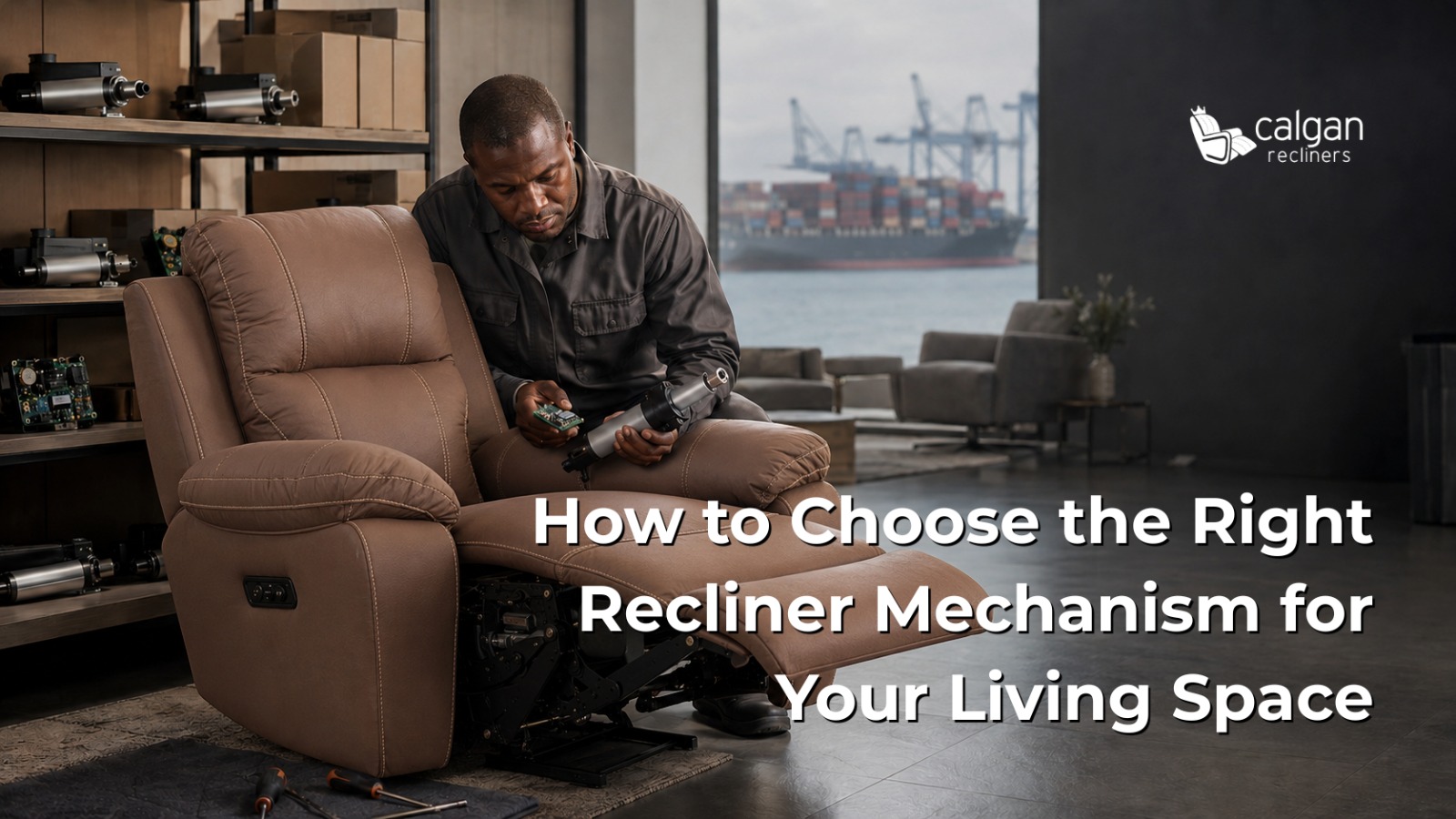
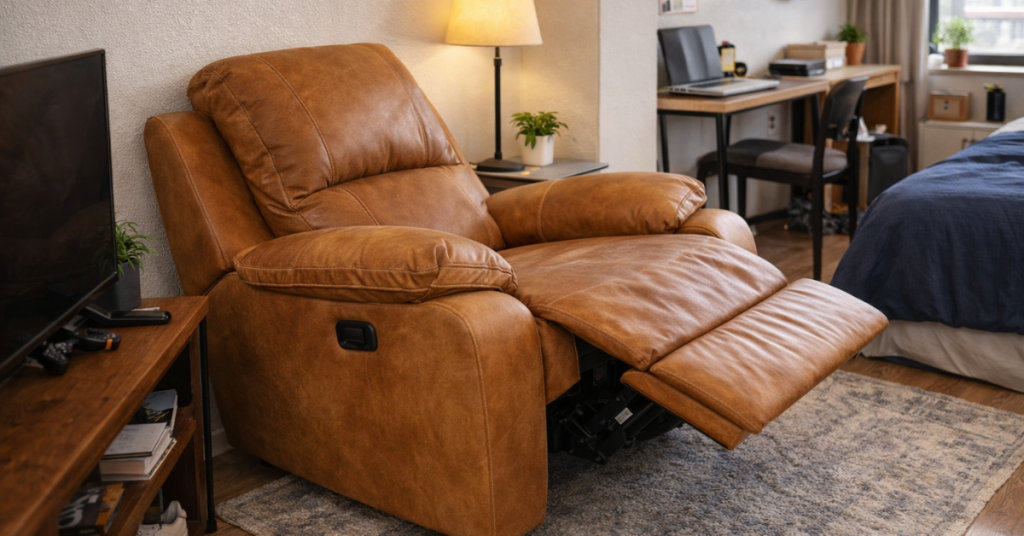



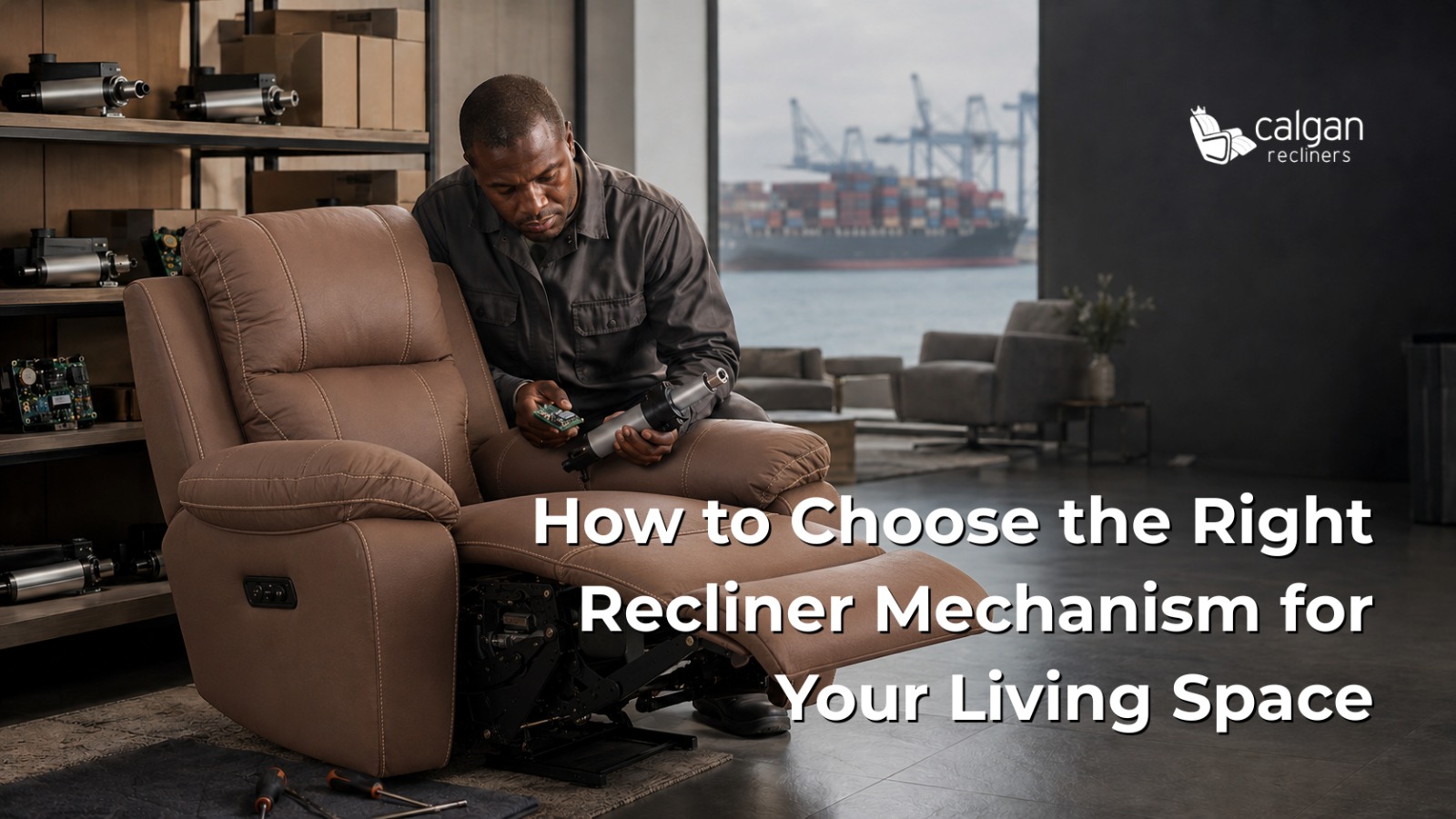
Most people buy a recliner with their eyes. They walk into a showroom, drop into the seat for about ten seconds, run a hand over the leather, ask about the price and sign. Two years later the footrest sits skew, the back no longer holds position, and nobody can remember who made the frame inside the chair.
The upholstery is the part you look at. The mechanism is the part that decides whether you still like the chair in year six. Get that choice right and everything else is preference. Get it wrong and no amount of good leather saves you.
A recliner is two products in one. There is the chair, meaning the frame, foam, springs and covering. Then there is the mechanism, which is a steel linkage of arms, pivots, brackets and stops bolted into the seat box. That linkage is what folds the footrest out, drops the backrest and holds your body at a fixed angle without collapsing.
Manufacturers rarely build their own mechanisms. They buy them in, then build a chair around them. Two recliners that look identical on a showroom floor can carry completely different steelwork underneath, at completely different prices.
Worn leather is cosmetic. A failed linkage ends the chair. Reupholstering is possible and often worth doing. Replacing a mechanism that nobody stocks parts for usually costs more than the chair is worth, so the unit goes to the dump.
That is the reason mechanism quality deserves more of your attention than the colour swatch does.
Every recliner does some combination of three things. It lifts a footrest, it drops a backrest, and it manages the transition between the two. Cheaper linkages tie all of this to one motion, so the back only reclines once the footrest is fully out. Better units separate the movements, letting you sit upright with your legs raised, which is the position most people actually want when they are watching something or reading.
The classic setup is a side lever or a pull strap. You release a catch, the linkage unlocks, and your body pushes the back down as the footrest swings up. Closing it means pulling your legs in and shoving the footrest closed with your calves.
It is simple, mechanical and repairable. There is very little to go wrong apart from a snapped cable or a bent arm, and both are cheap fixes if the brand stocks spares.
Push back units have no handle. You lean into the backrest and the chair follows. Some models lift a footrest at the same time, others just tilt the back and let your feet dangle. They look neater, since there is no lever hanging off the side, but they need firmer pressure to open and they give you fewer stopping points.
Fewer parts means fewer failures. No plug point needed, so the chair can sit anywhere in the room. Lighter to move when you paint or shift furniture. Lower price for the same build quality, meaning your budget goes into steel and foam rather than motors. For most family lounges, a well built manual unit outlasts a mid range powered one.
Closing a manual recliner takes real effort from the legs and lower back. Shorter people struggle to reach the footrest with enough force. Anyone with knee, hip or shoulder trouble will find the action awkward within a year or two. There are usually only two or three fixed positions, so the perfect angle either exists or it does not.
Powered chairs replace your body’s effort with a linear actuator, which is a small motor driving a threaded rod inside a tube. You press a button, the rod extends, the linkage opens. Let go and it stops exactly where it is, which gives you an unlimited number of positions rather than three.
Controls range from a basic two button pad stitched into the arm to touch panels with memory positions, USB ports and lighting.
A single motor moves the whole mechanism as one piece, so the back and footrest travel together. A dual motor unit runs the footrest and the backrest independently, letting you raise your legs with the back still upright. That second motor is what most buyers actually want and often the thing salespeople forget to mention.
Dual motor units cost more, draw more current and add another part that can fail. For a reading chair or a home theatre seat, the extra control earns its place. For a chair used mainly for napping in front of the television, a single motor is fine.
This matters in South Africa more than anywhere. A powered recliner in an open position with no electricity is a large obstacle in your lounge. Most decent power units accept a rechargeable battery pack that clips underneath and gives you a few dozen operations per charge. If the chair is your primary seat, treat that pack as compulsory rather than optional.
If the house runs on an inverter, check the draw of the motor before adding it to the essential circuits. Recliner motors pull hard for a few seconds and then nothing at all, so the surge figure matters more than the running figure.
Decide where the chair lives before delivery day, then get a plug point put in nearby. Running an extension lead across a walkway is how people trip and how cables get pinched under the mechanism. In a two seater or a suite, work out which end the transformer sits at, since some units run one cable to the whole piece and others need a plug per seat.
Motors fail. Transformers fail. Control boards fail. None of that is a reason to avoid power, but it is a reason to ask exactly one question before buying: does the supplier hold replacement motors and boards locally, and what is the usual turnaround? If the answer involves a shipping container from overseas, walk away.
Here is a useful visual comparison of how these mechanisms differ in practice:
https://www.youtube.com/watch?v=IZmNXtlCh_g
A conventional recliner pivots backwards, so the top of the backrest travels towards the wall as you open it. Most standard units need somewhere between 25cm and 45cm of clearance behind them. Showroom floors are enormous, which makes every chair look smaller and every clearance requirement look irrelevant. Your lounge is not a showroom floor.
A wall hugger, sometimes sold as a zero wall or wall away mechanism, works differently. As the back drops, the entire seat slides forward on a track. The backrest stays roughly where it started, so the chair can sit within about 8cm to 12cm of the wall.
The trade off is a more complex linkage, a slightly higher price, and a chair that eats floor space at the front instead of the back. In a townhouse lounge or a flat, that trade is usually worth it. Many recliner chairs are now built on this style of mechanism by default.
The number on the spec sheet is the closed depth. The number you need is the open depth, measured from the back of the chair to the tip of the extended footrest. On a large single seater that figure often passes 1.6m. Add walking space in front of it and you have the real footprint.
Mark it out on the floor with masking tape before you buy. It takes five minutes and it has saved more people from a bad purchase than any brochure ever has.
A chair that fits the room still has to get into the room. Measure the narrowest doorway, the turn at the top of the stairs and the width of the passage. Ask whether the backrest detaches, since most decent recliners come apart at the back for exactly this reason. Two seater and three seater units are where this catches people out most often.
Chairs float in the middle of open plan spaces, so the back panel is visible from the kitchen or dining side. Wall hugger mechanisms lose their advantage here, since there is no wall to hug. What matters instead is the finish on the rear panel and how stable the chair feels when it is not braced against anything.
Tight rooms reward wall huggers, compact two seaters and manual mechanisms without bulky motor housings. Measure the walkway between the open footrest and the coffee table. If it drops under 60cm, someone is going to bark a shin every evening.
Viewing rooms have their own rules. Seats are often placed in rows, sometimes on a raised platform, and everyone is reclined at the same time. That means clearance between rows, not just behind them. Headrest height matters, since a reclined head sits lower than an upright one and the screen angle changes with it. Purpose built home cinema seating usually pairs power mechanisms with adjustable headrests for this reason.
Reading posture is not viewing posture. You want the legs up and the back close to upright, which points straight at a dual motor unit or a manual chair with a separate footrest release. Lighter frames make sense here since these chairs get moved more often.
The simplest option and the easiest to place. Every seat operates independently, nothing is shared, and repairs affect one chair rather than a whole suite.
Two seaters either recline as a pair or as two independent seats. Independent is what you want. A console between the seats adds storage and cup holders but pushes overall width out by 25cm to 35cm, which is often the difference between fitting the wall and not.
In most corner units the wedge seat does not recline at all, since there is no room for the linkage. Chaise sections usually have a fixed leg rest instead of a moving one. Ask which specific seats move before you fall in love with the layout drawing.
Running power on the two most used seats and manual on the rest is a sensible way to control cost. The thing to watch is seat height. Power mechanisms sometimes sit a few centimetres higher than manual ones from the same range, and a suite with mismatched seat heights looks wrong from the moment it lands.
Turn the chair over or lift the skirt. You want thick pressed steel, welded joints at the main pivots, and rivets that sit flush rather than proud. Thin, flexible steel that gives when you press it with a thumb will fatigue at the pivot holes within a few years.
Manufacturers test mechanisms by opening and closing them tens of thousands of times. Ask for the tested figure. A household chair used three times a day sees roughly 1,100 operations a year, so a unit tested to 25,000 is built for two decades of normal use. Anything untested is a gamble.
Sinuous steel springs across the seat box outlast elastic webbing by a wide margin. A sagging seat base changes the angle at which the linkage carries the load, which puts stress exactly where the mechanism is weakest.
Low density foam collapses first, drops your hips lower and shifts the load path through the linkage. Ask for the foam density figure. Anything at or above 30kg per cubic metre in the seat is reasonable for daily use.
A recliner flexes its covering every time it opens. The front seat edge, the arm tops and the fold behind the backrest take the punishment. Full grain and top grain hide handle that flexing far better than bonded or split hide, which cracks along the fold line within a few years. If you are buying leather recliners, spend the extra on hide quality in the contact areas and let the sides and back run in a matched material.
Fabrics are rated by rub counts. For a daily use recliner, look for something rated above 30,000 rubs. Loose weaves pill along the moving panels and pets find the footrest edge irresistible.
Never spray liquid directly into the gap where the footrest folds. Dust, hair and crumbs collect in the linkage and turn into a grinding paste. Vacuum that gap with a crevice tool once a month and the mechanism stays quiet.
A lift mechanism tilts the whole seat forward and upward, bringing the user close to standing before they take any load on their knees. This is a different mechanism to a standard recliner, with a stronger motor and a reinforced base, and it is the single biggest quality of life improvement for anyone with limited mobility at home.
Chairs built for clinics have wipe clean covers, sealed seams, locking castors and stronger frames. Families caring for someone at home increasingly buy medical recliners for exactly those reasons, since they handle long hours of sitting far better than a domestic chair does.
Measure from the floor to the top of the closed seat cushion. For most adults, 45cm to 50cm allows a clean stand. Arms need to be firm, wide enough to push down on, and roughly 20cm above the seat.
Two chairs, same look, same leather, half the price. The difference is almost always the steel underneath.
Sit for five full minutes in the reclined position. Discomfort in the lower back and pressure behind the knees show up around minute three, never in the first ten seconds.
Footrest length suits a 1.7m user and leaves a 1.9m user with hanging heels. Seat depth that suits a tall user leaves a shorter one unable to touch the floor. Test with the actual people who will use it.
Open it completely. Look for gaps at the arms where fingers can go, check the noise, push sideways on the backrest and see how much it wobbles.
Every six months, tip the chair forward and check every visible bolt. Pivot bolts work loose first, and a loose pivot wears an oval hole into the steel that no amount of tightening later will fix.
Coins, remote controls, pens and pet fur all find their way into the mechanism. Clear the gap regularly and use a light spray of dry lubricant on the pivot points once a year. Avoid thick greases, since they collect dust and turn gritty.
Grinding or clicking on opening. A footrest that lifts unevenly on one side. A backrest that no longer holds its position. A motor that hesitates before running. Any of these caught early is a small repair. Ignored for six months, it is a new chair.